Saturday, 15 March 2008

Bagpipes (and Art and Food) in Edinburgh


Spent the weekend in Edinburgh and caught this piper on High Street in Old Town. At least on the weekend, from almost anywhere in the heart of the city you can hear bagpipes somewhere in the distance. Personally, being a Philip Glass and Steve Reich fan, I like the music a lot. The background drone feels to me like Tibetan throat singing and the repetitive nature is (for me) like a traditional version of Philip Glass.

Edinburgh is a beautiful city and we were lucky enough to be able to have the use of the Dyckhoff flat on Jeffrey St. for Saturday night.

Seeing this Freud at the Modern Gallery was an emotional experience for Penelope. She (and I) have been studying Freud's work for years and (is it possible) have never seen a painting of his in person. The embarrassing thing for me is that I looked at this painting my first time through the gallery some weeks before and did not recognize it as a Freud!

While we were in town, we spent time in the National Gallery and in the Portrait Gallery both of which have wonderful collections. The famous Sargent Lady Agnew of Lochnaw is in the National Gallery. This is another painting Penelope has studied from reproductions for years. Aside from the permanent collection which is extensive, the portrait gallery was showing the BP sponsored portrait award which included 60 works chosen from over 1800 entrants. This show was both inspiring and frustrating. There seemed to be a rather too strong emphasis on photorealism with the more abstract work selected for the show being somewhat weak.

We had some very good meals, including lunch in the Dome on George Street where I had Haggis wrapped in Filo dough with a whiskey, mustard and cream sauce. This is the old bank of Scotland building. We had a good (but in no way exceptional) meal at the Barioja Tapas Bar on Jeffrey St. The best part was the nice Rioja we drank. Lunch the next day in an anonymous pub on High Street where I had a very good Steak and Ale pie.

Edinburgh is a beautiful city and we plan to spend more time there soon.

Sunday, 9 March 2008

Penelope is here!

Penelope (my wife) is here for a month. Here she is, jet lagged by the North Sea.

Among other things, she's a painter, here's a link to her web-page PenelopeCaldwell.com. Trying to let studio space in St Andrews is turning out to be a challenge. She'll be here for a month now, and will be back for May into mid-June. I've taken out an ad in the St Andrews Citizen looking for space.

There is an charitable organization here in Scotland called Wasps Artist's Studios that has building all over Scotland for use as artists studios -- 16 in all. But the waiting list is quite long for space, and although there are a few within reasonable commuting distance of St Andrews, they are full.

Sunday, 2 March 2008

The Lomond Hills of Fife

I climbed West Lomond Hill, the highest point in Fife. The day was blowy and cold, and I had a bit of a late start so I only did the West Hill which is the higher of the two. Starting from the Craigmead carpark, the walk up the West hill is about 4 1/2 miles round trip with an elevation gain of 656 feet. The walk up East Lomond hill is about half the distance gaining half the elevation. The path I took to the top (straight up the east side) is clearly visible if you click on the photo.

This shot shows the summit marker. Walking there I passed a very serious woman walking alone. She was dressed head to toe in a red Gortex suit and using a pair of ski poles for balance. She looked to be training for an expedition to Greenland. I asked he about the trail to the top up the east side and she told me that which ever way I wanted to go was my choice and that there were many trails. She volunteered that she'd already been to the top and was taking a different one round the south side. When I arrived at the summit the wind must have been gusting to 50 mph; I was almost blown over trying to take a few photos. There was a woman with about eight lightly clad children hunkered down in the rocks nearby. On my way down, I passed a few more people who all commented what a nice day it was.

The town just below the hills is Falkland, which was mobbed with walkers dressed to the nines for hiking wearing rain jackets and hiking boots, with many wearing breeks and carrying walking sticks or ski poles. The town itself is magnificent with beautiful stone houses, an old castle and a church and with streets barely wide enough for a single car to pass.

The hills are visible from many parts of Fife and I have used them for navigating while driving. In the panorama below you can just make out (on the right side) the Firth of Forth and (on the left) the Firth of Tay.


Saturday, 1 March 2008

Cooking for one.

I'm in the habit of cooking something on the weekend that will last most of the week. That way, when I get home from work at seven or later, cooking is not a chore.

When I first arrived in Scotland, I bought the casserole dish pictured here (there was nothing like it in the house) since a pot like this is fundamental to much of my cooking. It's nothing special, I picked it up in the grocery store cooking isle, but it's perfect for my purposes.

Pictured is my imitation of cassoulet. Haricots, a hunk of pork and some left over roast chicken, wings and drumsticks. Sorry, no sausage or duck confit in this one -- maybe next time. Soak the beans overnight, drain them and leave them in the casserole dish. I had a wedge of pork rump, fat on, which I browned in a bit of olive oil and then added to the pot with the beans. Sauté four five or even six cloves of chopped garlic in olive oil and then add three medium sized onions, diced; chopped parsley, salt, coarse ground pepper, thyme and I threw in some rosemary too. A bay leaf or two would be good, but I didn't have one. Once the onions are soft add a couple of cups of dry white wine, and let that reduce for a bit before adding the chicken stock - about 8 cups. After it gets to a boil, pour this over the beans, just covering them with the liquid. I put it into the oven with the top on just at a simmer and left it for a few hours. When I came back I added the chicken legs and thighs and turned up the bringing it to a good boil and remove it from the over. The whole thing takes an hour in the kitchen and I'll be eating this all week - and loving it.

Last week I made a rather amazing recipe from Mark Bittman's column in the NY Times, Short Ribs with Coffee and Chilies. I never, in a million years, would have thought of braising beef in coffee and red wine, but it is wonderful. I recommend watching the video linked at the bottom of the article Coaxing Exotic Flavor From Familiar Elements. This recipe uses an idea I've been using for some time, using chilies - not for their hotness but for their flavor. A bit of chili can make food taste round in your mouth, without really being hot. I use them often in red wine based stews. In the kitchen here, there were some small dried chilies hanging on the wall which worked fine - I think that at one time they may have been a decoration, but I've eaten most of them. I did not find "short ribs" but used a very inexpensive "Scottish Boiling Beef" which seems to be much the same cut.

My first week here in Scotland I made a beef stew in red wine; also using the chilie trick. I follow the method I learned from Rick Bayless's classic Mexican cookbook Authentic Mexican: Regional Cooking From The Heart of Mexico for preparing dried chilies. Slit them open to remove the seeds, trying not to crumble them completely. Dry roast the chilies by putting them in a hot dry cast iron frying pan and pressing them flat with a fork or spatula. They'll bubble up and brown. Don't worry if they burn a bit but you don't want them black. I put them in a cup with a bit (say 1/2 cup) of water and microwave them (Bayless does not use the microwave) for a minute or so. Be careful when you remove them - a whiff of the steam will take your breath away. Drop them in a blender and you have a chili sauce to add as needed.

Bittman's philosophy of cooking largely matches my own. In general I know that, with a bit of care and minimal effort, it is possible to prepare food at home that is far better than that served in all but the finest restaurants. Probably everyone already knows this. If you don't think so, watch the Bittman video to see how easy it is to make this rib recipe.

Saturday, 23 February 2008

Bookshops I know and love

After visiting the National Gallery I drove into the heart of Edinburgh and managed to find a couple of very nice used and rare bookshops. Armchair books is at 72-74 West Port and occupies two narrow shops that are adjacent to one another. The owner is somewhat cranky as evidenced by a sign on the door saying something to the effect of: "The government is trying to close me down and so, at any moment, this shop may revert to a private premises in which case you are my guest." The owner was there and I asked him about the sign, and was told about the governments efforts to close him down because he is deemed a fire hazard, among other things. In any case, I asked him if there were any other shops nearby and he said the only one he could compare to his own was in Paris, Shakespeare & Co.. I've been to Shakespeare & Co. and I think the comparison may be a bit of a stretch. But actually, I may like Armchair books better, it is dustier, has a broader selection and is a bit less "Literary". So I pressed him a bit more and then he did point me to McNaughtan's bookshop about a mile away. It was getting late and so I decided to visit McNaughtan's on another visit. As I walked towards the car park, and less than a block from his shop I hit another very good second hand and antiquarian bookstore, almost as good as his own I'd say. This one is Edinburgh Port Books. And there was another smaller one half a block further on. Now that I'm back in St Andrews and have access to the web I see that there was another shop (Andrew Pringle) less than a block downhill from Armchair that he neglected to mention as well. In any case, I bought two books at Armchair, one an inexpensive copy of Negly Farson's Going Fishing first published in 1942 and which is illustrated with woodcuts by C.F. Tunnicliffe.


This image alone is worth the cost of the book. I also purchased a copy of Salmon Fishing by "Tavener & others" first published in 1935 and which is volume X in The Lonsdale Library of Sports, Games & Pastimes published by Seeley Service & Co. Limited in London.

As for book shops ...There is another Shakespeare & Co. in Berkeley CA as well. It's not particularly noteworthy. Last time I was there, I asked if they were affiliated with the Paris store and was told that they were. This is contradicted by the information on the Paris store's website. With Moe's books and Black Oak Books also in Berkeley, it must be the best used book town in the world. I think, for scholarly titles Moe's and Black Oak would be hard to beat. Black Oak has the most extensive collection of math and logic books anywhere. (No, I haven't been to Powell's in Portland.) The Strand in NYC is wonderful as well although I seem to recall having left a bit disappointed the last time I was there. In 1988 or so I bought used technical books in London at Skoob books near Russell Square. I can still remember the name because "Skoob" is "books" spelled backwards and so the name is a palindrome. I just googled them to see if they're still around and in fact, they advertise themselves as The best secondhand bookshop in London. When I was last there, they had an very good collection of logic and theoretical computer science titles and I am looking forward to getting there again when Penelope comes in March and we visit London together to look at art.

Scottish National Gallery of Modern Art.


Drove to Edinburgh for the second time today. I went to the Scottish National Gallery of Modern Art and the Dean Gallery with is just across the road. Unfortunately, the Dean was between shows and so there was little to see. There was some surrealist work on the first floor that was nice to view in an intimate space There was a small collage by Kurt Schwitters that, as always, was beautiful.


On the lower floor of the National Gallery of Modrn Art there was a sparsely hung show by landscape painter Carol Rhodes. The paintings are oil on masonite, mostly aerial landscapes and showed a very nice sensibility for the quality of oil paint on masonite. Individually, many were very good, but overall the presentation was somewhat weak. There was an awkwardness of the drawing in a number of the paintings which, if intended, just wasn't quite wrong enough to be right. But I am being too harsh, the quality of paint reminded me of the early work of my friend Philip Rosenthal and I really enjoyed the show.

Upstairs they had two paintings by Gerhard Richter. One of the paintings is from his blurred photo realist series and the other was from the "Abstract Painting" series. It was nice to be able to see them together in the same room. I must admit that I never really have much appreciated the mechanistic results of his abstract painting series. This one looks pretty good in the small image I included here, but in person, the medium sized (5'x5') painting is lacking in the same way they always are for me.


There was a Richard Long installation of an "X" made of slate behind the building called "The Slate Cross". In size it is maybe 30'x30' and is made of 8 tons of slate. Looking for some more information on it, I see that a photo of it from above (scroll down a bit in page linked to his name), it has a nice effect, better than walking around it at ground level. In general, I like Long's work quite a bit more than Andy Goldsworthy whose work is quite similar but which is better known. The content in Goldsworthy's work seems to be its prettiness in the context of nature and it is contrived for just this effect. Long's work (going back to 1960's) is conceptual in content but concrete in implementation. The artifacts created from his explorations might be mistaken for those of Goldworthy. Still, this piece didn't do much for me in person, perhaps I'm not attuned to the aesthetic of Cornwall slate. I am sorry to have missed his recent show "Walking and Marking" of which this piece is remnant.

I did very much like a conceptual piece by a Scottish artist named Douglas Gordon called List of names random started in 1990 and ongoing. It is essentially the all the names he can recall of everyone he's ever met. The names are carefully stenciled on a wall in the stairwell that is three stories high. His account of the process, of forgetting and misremembering is important. And besides, how did they get all those names so straight and true.

There is a very nice Vuillard on the third floor
La causette [The Chat]
painted in 1893. Vuillard's work is often small (this one is 12"x16") and precious and the use of black (real black) in this painting is stunning when seen in person. The image here does not do it justice.


So this brings up a rather interesting second order aspect of art works; some work seems to photograph well, looking better in photographs than perhaps it does in person, while other work does not photograph well but is good in person. It's possible that the image of the Vuillard could be better, but in my experience this is work that has to be seen up close to be appreciated to full effect. This failure of representation of representations was a theme in William Gaddis' dense novel The Recognitions.

The gallery does not permit photography, which is rather disappointing. At the Metropolitan Museum of Art in NYC, you may take photographs, but you must not use a flash, which seems a reasonable rule to me. The images I included above fall under fair use (or since I am in the UK, fair dealing) of copyrighted material and all copyrights are held by the artists.

Thursday, 21 February 2008

Nottingham -- DTP 2008.

Spent the first part of the week in Nottingham at the Workshop on Dependently Typed Programming. It was a very interesting workshop organized by Thorsen Altenkirch and his group at Nottingham. Programming with dependent types in Nuprl is what I've been doing in my research for some time. There seems to be a kind of moment right now when it has come into its own.

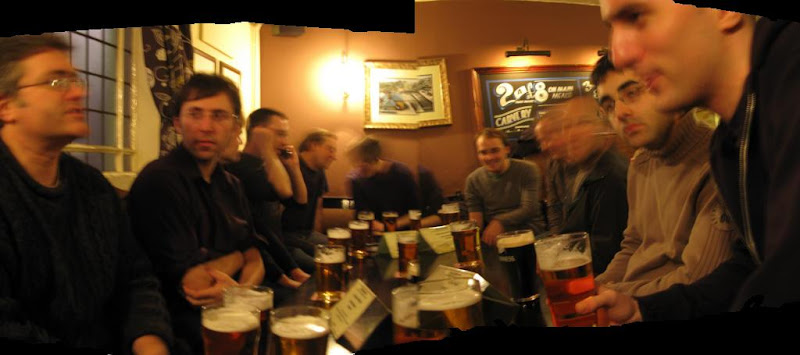
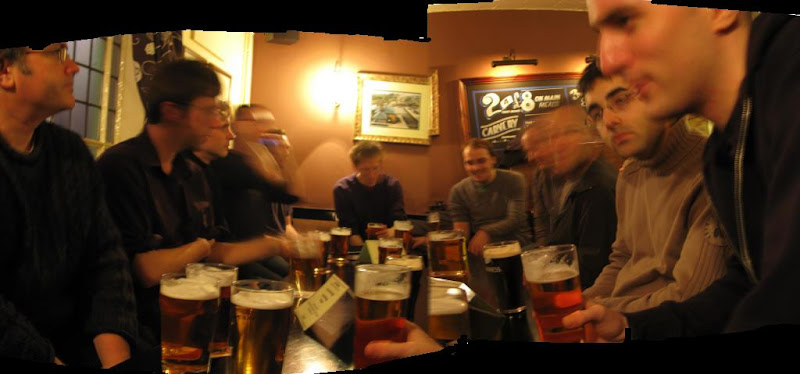
I didn't have time to take many photos, but here's another pub photo (an almost lost genre that I am working to reestablish) of some of the conference attendees.


Left to Right: James McKinna (now at Nijmegen), Noam Zeilberger(CMU), Xaveier Leroy [mostly hidden](INRIA), Connor McBride (Alta Systems), Sebastian Hanowksy, Ulf Norrell [blurred](Chalmers), Peter Morris(Nottingham), ???, Randy Pollack[blurred] (Edinburgh),???, Sean Wilson(Edinburgh).

Left to Right: James, Noam , Xavier[more visible here], Connor [blurred by duck], Sebastian [hidden], Ulf, Peter, ???, Randy [blurred],???, Sean.

These are low light hand held shots taken at F2.8 with an exposure of 8/10 of a second taken with a Canon G9. They've been stitched together with the Canon software which didn't do such a good job here (look at the picture on the back wall) but they weren't very carefully panned to match up either.